

From Boxes to Shelves: What It Takes to Make Montessori Materials Usable
Particularist
opened the box; I felt a mixture of anxiety, overwhelm, and concern.
There really was a lot in there. Culture and geography mixed with language, geometry, life science, and zoology. Different companies, different sets, different levels. Pieces that belonged together were separated, and things that looked similar did not necessarily belong to the same work.
I could recognize enough to begin. This word belonged with a classification lesson. That card was about seed dispersal. Another belonged with the history of written language.
But recognizing a piece is only the beginning.
I still needed to separate the subject areas, identify the individual materials, check what was there, investigate what might be missing, and figure out where each work belonged. Then I needed to make it possible for someone else to find it, use it, and put it away.
That's what my current Montessori inventory work looks like.
This inventory contract is one part of my work through The Multilingual Mind, alongside other engagements in Spanish immersion development, teacher coaching, translation, and interpretation.
Parts of it feel like returning to my roots.
The work I remember doing as an assistant
For people unfamiliar with Montessori assistant roles, the expectations vary considerably. Class size, the experience of the assistant and lead teacher, school practices, and institutional culture all shape the job.
In the three schools where I worked as an assistant, I helped maintain classroom order and flow so the lead could give individual lessons and follow up.
That included a great deal of checking, cleaning, sorting, and preparing.
When a child returned a pouring work, for example, I checked whether it was in its place, whether the pieces were arranged and clean, and whether it was ready for the next person. I also considered what that child could reasonably manage independently and where they still needed support.
I checked at the end of the day, before children arrived, and throughout the work period. Dusting. Counting. Rearranging. Replacing labels, sorting storage, and finding the piece that had somehow ended up somewhere else.
I also worked with different labeling preferences. One lead wanted shelf labels and discreet labels underneath trays. Another, in an immersion classroom, wanted visible labels in both languages, distinguished by font and color. Other classrooms intentionally used very few visible labels.
I learned to work within those different approaches.
So when I sort, categorize, sequence, and label materials now, the physical work feels familiar. The scope is larger. I am also thinking about purchasing, documentation, continuity, and how the system will work for people who weren'tthere when we created it.
The sequence is inside the materials
One of the more complicated parts is bringing together materials from different companies.
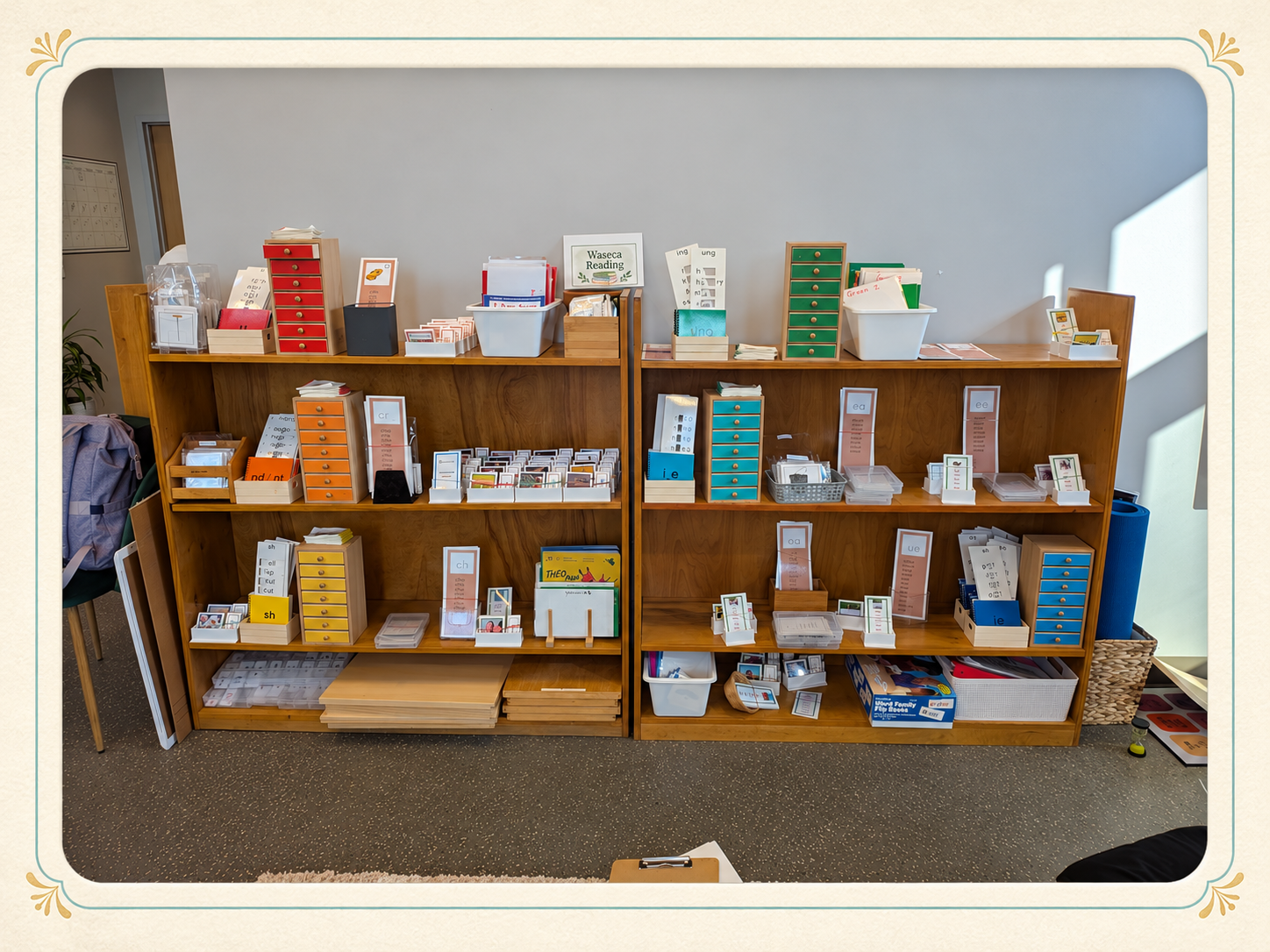
In the classroom's language area, Waseca Biomes and Nienhuis Montessori materials were already out, while other resources were in boxes. The box also contained ETC Montessori materials, Montessori Research and Development (Montessori RD) materials, and materials from other suppliers.
Each company has its own organization. The numbers do not necessarily line up.
For example, the ETC phonogram lists I was sorting included CH, SH, and TH in an early set. Those sounds appeared later in the Waseca progression already on the shelves. Montessori Research and Development had word lists and picture-to-word matching work that addressed those same sounds, but organized in a different sequence.
Keeping each company separate is one possible approach.
In this context, I preferred working with the teacher to integrate materials around a chosen progression, examining what each set actually asks the child to do. Where is the difficulty isolated? What knowledge does the work assume? What comes before it, and what can follow?
That lets us place related practice near one another even when the original sets’ numbers differ. Sharing a phonogram does not make two activities equally difficult, though. A word list and a story containing CH may require different vocabulary, additional spelling patterns, and different amounts of support. I need to consider the whole task when deciding where it belongs.
I enjoy this part. There is something so satisfying about pulling apart a box of mixed materials, recognizing what each piece belongs to, and seeing the progression take shape. It can be repetitive and tedious, and I still find it interesting.
It also lets us look more carefully at repetition.
I do not automatically want three versions of the same activity using the same words in the same way. I do want to consider the value of different ways to practice a skill.
A child might read a word list, match a picture to a word, build words with the movable alphabet, write them, or encounter them in sentences and stories. Those activities make different demands. Selecting letters with the movable alphabet also separates word building from the demands of forming letters with a pencil. Handwriting and handling materials matter, but they are different from the reading skills the child is practicing. These different forms of practice give the teacher different things to observe.
I want to ask whether a child can use the skill with different words and in different contexts, rather than assume familiarity with one box tells us everything.
Different practice, connected skills
Reading research gives me another way to think about those decisions. Hollis Scarborough's Reading Rope describes how word recognition and language comprehension develop together. Recognizing written words involves awareness of speech sounds, decoding, and increasingly automatic recognition of familiar words. Understanding what we read also draws on world knowledge, vocabulary, sentence structure, reasoning, and knowledge of how texts work.[1] That is a structured section of the Montessori work I am describing: sound games, phonogram lists, grammar work, nomenclature, conversations, and reading serve related purposes, but they do not all do the same job. Nor does the Rserve prescribe a single shelf arrangement or a child's sequence.
For me, the practical question is what the child is actually being asked to do. Building a word from its sounds is encoding; working from its printed letters to pronounce it is decoding. Matching a word to a picture can connect reading with meaning, provided the child reads the word rather than guesses from the picture. Reading it in a sentence adds demands that a word list does not. The Institute of Education Sciences recommends instruction linking speech sounds with letters, decoding and word-part analysis, writing and word recognition, and daily reading of connected text.[2] I see a reason here to offer purposeful, related practice with instruction and feedback, while keeping those different demands visible. Familiarity with one set does not establish mastery, and a change in activity is an opportunity to observe what transfers.
A child saw the boxes from another side
One encounter stayed with me.
I had seen a first-year student struggle to settle into alphabetizing and rhyming work. She seemed unable to settle despite repeated support and redirection.
Later, while I was inventorying those Word Study materials, I had the large storage organizer off the shelf and in front of me. That way, I could access the drawers and cards more easily.
From the back, you could see something the children would not ordinarily see when the organizer was against the shelf: rows of clear drawers with beautiful, differently colored cards inside.
She came over, curious about what I was doing.
She asked about my job, how I learned it, and what the work involved. She kept looking at the colors and explaining them. They did another child activity, and together they talked about how beautiful the colors were and how excited they were to move through them.
After a few minutes, her teacher finished another lesson and redirected her to her work plan.
This time, she went to get the work. She completed it quickly and effectively, appeared engaged, and did ’t need the further reminders I had seen her need.
I cannot know exactly what extraher interest that day, but I watched her encounter something familiar differently and then choose to work with it.
That moment reflected something I already love about Montessori materials. Their beauty matters to me. I remember it as a Montessori student, and I have experienced it as an assistant and teacher.
And beauty in a classroom includes the little toquecitos: the details a guide chooses, the room's arrangement, and the interests, languages, and cultural experiences that shape it.
There have been other lovely moments, too. While I was sorting preposition materials, a first-year student chose to work on an article box beside me. We talked about parts of speech and how they work together. I love having those conversations about language, and there is a particular pleasure in having one with a six-year-old who has pulled up alongside you with their own work.
Working in a classroom that is still working
This project is happening while children are using the classroom.
That changes what is possible.
An empty room gives you more freedom to take everything out, move furniture, and consider which subject areas fit in which spaces. Here, I am trying to preserve access to materials and minimize disruption throughout the work period.
The teacher and I collaborate in stolen moments: during planning, before or after school, at recess, or in a brief exchange when something comes up. We think separately and return to compare ideas. We try arrangements. Some stay. Some get moved back.
A lot of Tetris is involved.
New materials keep emerging from other boxes. Something that belongs in an area I have already worked through turns up elsewhere. I need to make room for it. Sometimes that means a small adjustment; sometimes it means changing shelf heights or shifting a larger section.
Children are adjusting, too. They sometimes return a material to where it used to live. They look for something in its old location. Those are understandable responses to a changing room.
In the phonogram-list area, repeated mixing showed us that the placement needed clearer support. We labeled the materials and their shelf locations, including distinctions between levels. I then saw children managing the arrangement more independently.
We are still working on crowding. Bringing materials out of storage has made some shelves fuller than we would like. The fact that a material can fit somewhere does not settle whether that is a good place for it.
The smallest child matters, even when she is absent
Before rearranging a teacher's room, I ask about non-negotiables.
What needs to stay where it is? What is working already? What might I be missing?
In this classroom, the teacher has welcomed substantial rearrangement. Her request is that the resulting organization be manageable for the children, with labels where they would help.
Her knowledge of the children has also corrected my thinking. That is an important part of how we work together.
While we were considering the grammar shelves, I checked whether the first-year students present could reach the materials. It was a little tricky, but they could.
The teacher reminded me that the physically smallest student was absent. She was shorter than the children I had checked with, and she needed materials near the beginning of the sequence.
That mattered.
The large grammar organizers require removing shelves from the wooden unit to make enough height. Their size leaves awkward space around them. Turning the arrangement around might use that space differently, but it would interrupt the sequence in several places.
We have also discussed shorter furniture, moving the larger unit elsewhere, and changing how the available shelves are used. Different widths, windows, and recesses in the room limit those options.
The geometry cabinet raises a related issue. Being able to touch a drawer is different from being able to slide it out level, carry it, and return it independently with its pieces in place.
These decisions remain in progress. We are also working within the school's review preparations and the teacher's presentation and observation needs.
I cannot make those decisions from a spreadsheet alone.
Giving the physical work a digital record
The inventory spreadsheet I developed has instructions at the front, subject-area sheets, and an inventory section. I have developed versions organized around AMS and AMI reference frameworks. They are independent organizational tools, not official accreditation checklists or substitutes for current program requirements.
For each material I inventory, I assign an identifying number, record it, and place a small removable label as unobtrusively as possible on the material or its container.
The number stays with the material. Its location can change.
For example, materials 14 and 15 were already recorded when a new Waseca grammar material arrived. The new material received inventory number 497, but its learning-sequence location was between materials 14 and 15.
I did not renumber everything. I recorded its location on top of shelf E, alongside the related materials, and placed it where it belonged.
That is why a useful handoff needs the material's name, inventory number, and actual location. Numerical order alone will not always restore the shelf.
Someone helping laminate and return materials needs that practical information. Someone planning purchases needs condition and completeness information as well. They can use different views of the same record.
Completeness also has to be honest.
If cards depicting animals and their families are mixed together, I may recognize that a young animal is missing its matching adults. But if an entire family is absent, the remaining groups might look perfectly complete.
Without a reliable contents list, I may not be able to verify the full set.
The spreadsheet allows complete, incomplete, and unknown statuses, with notes. A material can be functional and ready for use while its completeness remains unknown.
My experience helps me know what to look for. It does not remove the need for references.
When manuals are missing, I have also used ChatGPT to help investigate unfamiliar materials or recall possible names. Those suggestions need checking, and anything I cannot verify remains marked as unknown.
The handoff is part of the work
In another classroom, newly arrived Waseca materials raised a different logistical question: how could they be prepared for durability while children were already waiting to use them?
We have been discussing lamination and how to keep materials organized and available during that process.
At present, that work would likely be handled by volunteers or school staff. My involvement may be limited to showing people how to find and use the inventory. Writing preparation instructions, training helpers, or doing the lamination myself would be possible additional work, depending on what the school wants to contract for.
I have years of experience making materials and using different laminators. Some tasks can be shared readily with clear directions. Other tasks, especially sequencing and verifying completeness, need more specialized knowledge or access to reliable documentation.
A useful system should let us share the work without expecting every helper to know everything.
And allocating tasks still takes planning. Asking teachers to do preparation in their spare time does not make the time requirement disappear.
One shelf is a place to start
If a whole-classroom inventory feels overwhelming, start with one shelf.
Watch whether the children using it can find a material, take it out, and return it. Can they manage the container as well as reach it? Is there enough room to put it back? Where are they needing an adult to step in?
Then check one set. Record what you can establish about its condition and contents, and mark what is still unknown. Give it an identifying number and a recorded location so another person can find it, too.
That is a small place to begin seeing what the larger project will require.
What I want school leaders to see
A finished shelf shows only part of this work.
Behind it are decisions about identification, completeness, condition, sequence, reach, space, maintenance, purchasing, and what the next person will need to know.
Training, experience, and personal interest help me navigate those decisions. Someone with a different background may need more time, more references, or more support. That is a planning consideration, not a reason for shame.
Schools and educators are already carrying a great deal. An inventory project needs time, access, and resources. Bringing in a contractor costs money. Doing it internally costs staff time. Sharing parts with volunteers still requires preparation and coordination.
If a school has mixed sets it cannot confidently identify, missing documentation, materials children struggle to access, or an inventory project that cannot fit into existing staff time, those are concrete reasons to discuss outside support.
This is work I can help with: identifying and sequencing materials, documenting their condition and completeness, and developing an inventory system the school can continue to use. For educators doing the work themselves, my AMS-Aligned Lower Elementary inventory spreadsheet offers a place to record materials, locations, condition, completeness, and follow-up needs. Other levels and versions are available in The Multilingual Mind's Teachers Pay Teachers store.
I want to earn a living from the expertise I have built, and I want that expertise to make a hard job more manageable for other people. Part of that is sharing usable tools so every school does not have to reconstruct the process from the beginning.
I am proud of the shelves. I enjoy the sorting, the details, and the satisfaction of finding where something belongs.
And I love seeing children choose materials that had been packed away, ask questions about them, and talk with one another about what they are learning.
The question I am working toward is bigger than whether everything has been counted:
How do we make what the school already owns something the people in the classroom can actually find, use, and maintain?
Reading research referenced
Scarborough, H. S. (2023). The Reading Rope: Key Ideas Behind the Metaphor. The Reading League. Explanation by the model's creator; the Reading Rope was published in Scarborough's 2001 chapter, “Connecting early language and literacy to later reading (dis)abilities.”
Foorman, B., et al. (2016; revised 2019). Foundational Skills to Support Reading for Understanding in Kindergarten Through 3rd Grade. Institute of Education Sciences, What Works Clearinghouse.
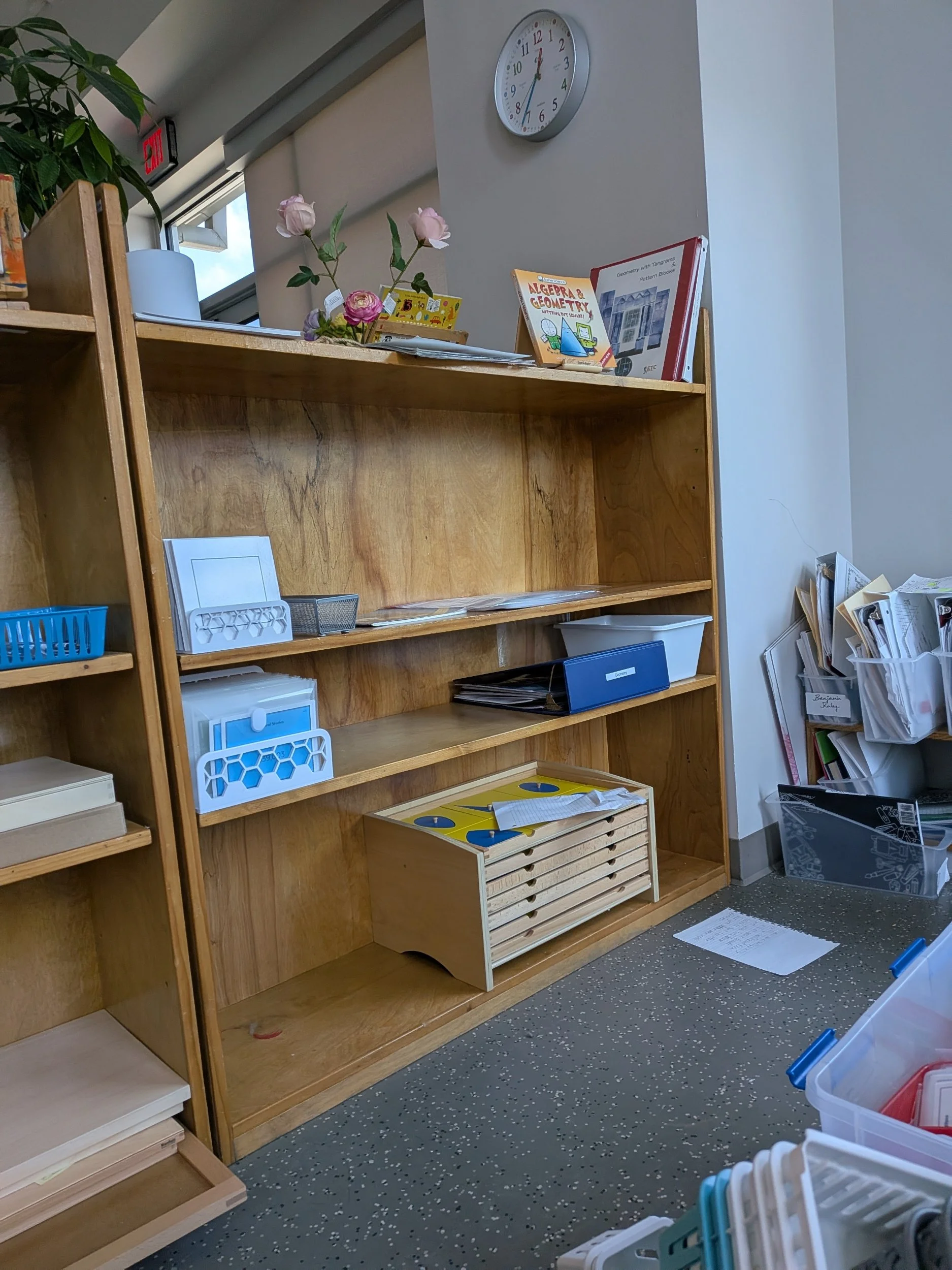
An earlier stage of the geometry shelf: bins, cards, and organizers waiting to be checked and brought into a usable arrangement. Materials already on shelf and not sequences.
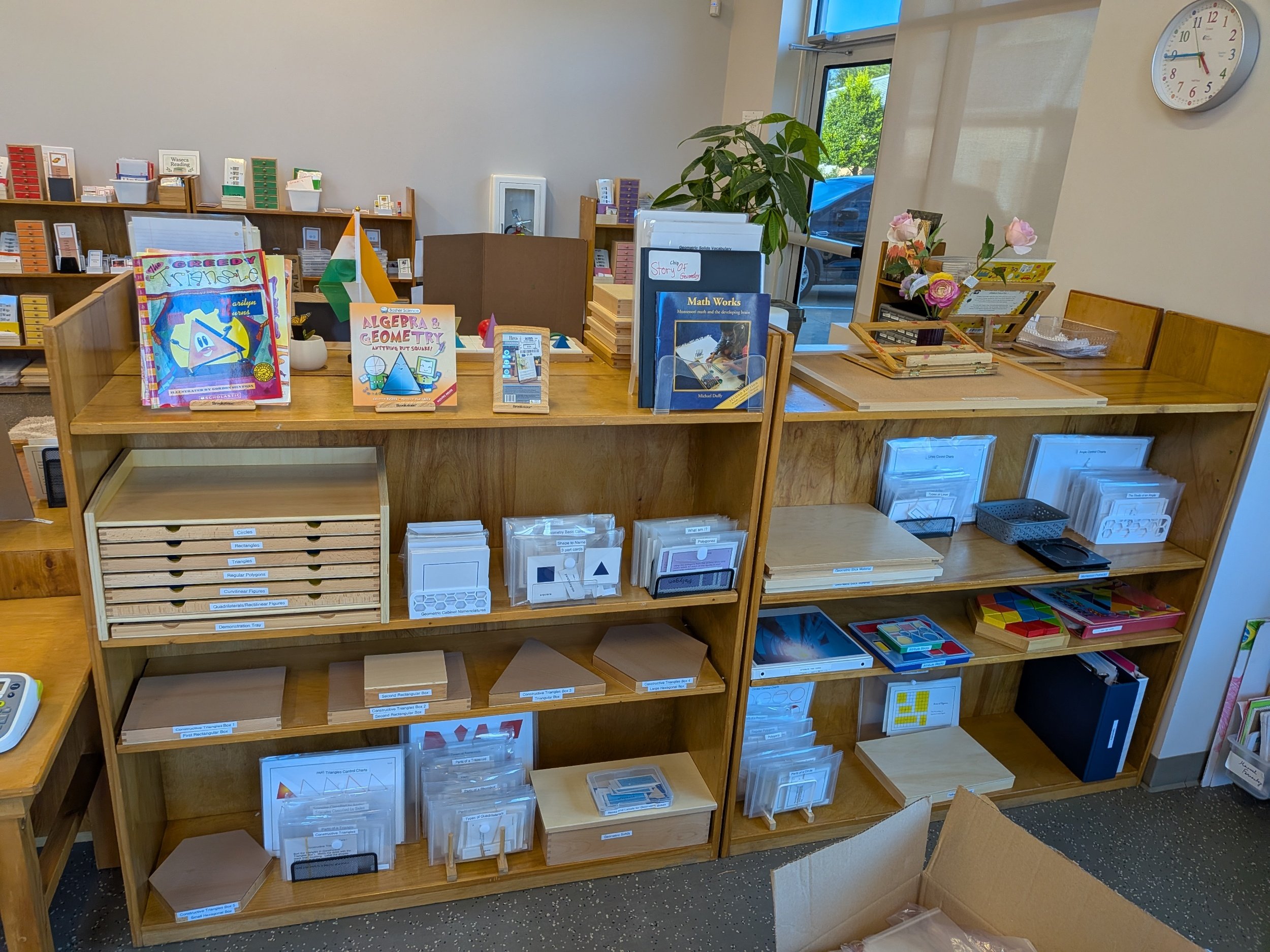
Finished geometry nomenclatures brought together on the shelves between traditional Montessori materials, with related practice arranged around a shared progression. Access, spacing, and maintenance are still part of the work.
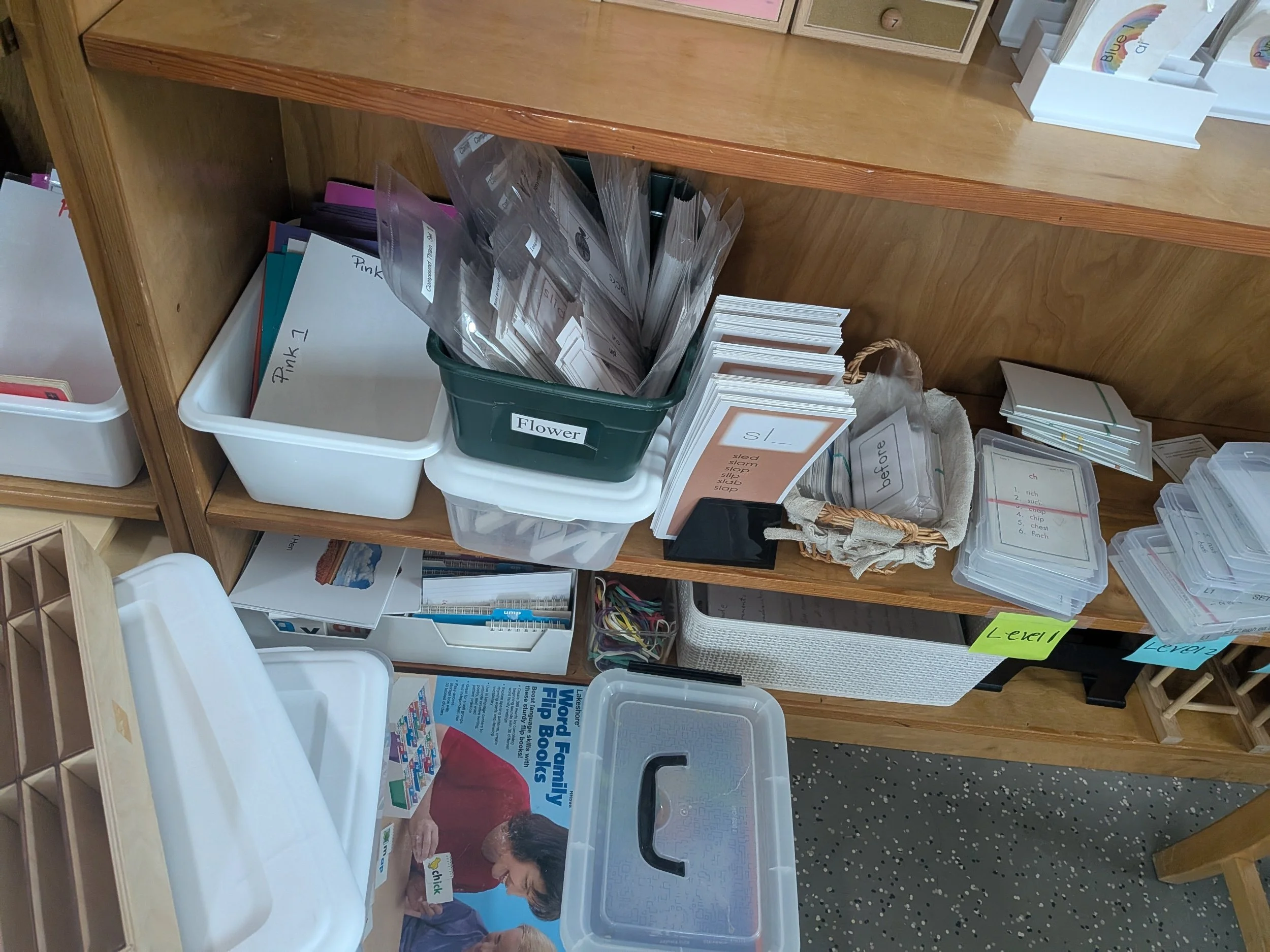
An earlier stage of the language shelf: bins, cards, and organizers waiting to be checked and brought into a usable arrangement. Materials already on shelf and not sequences
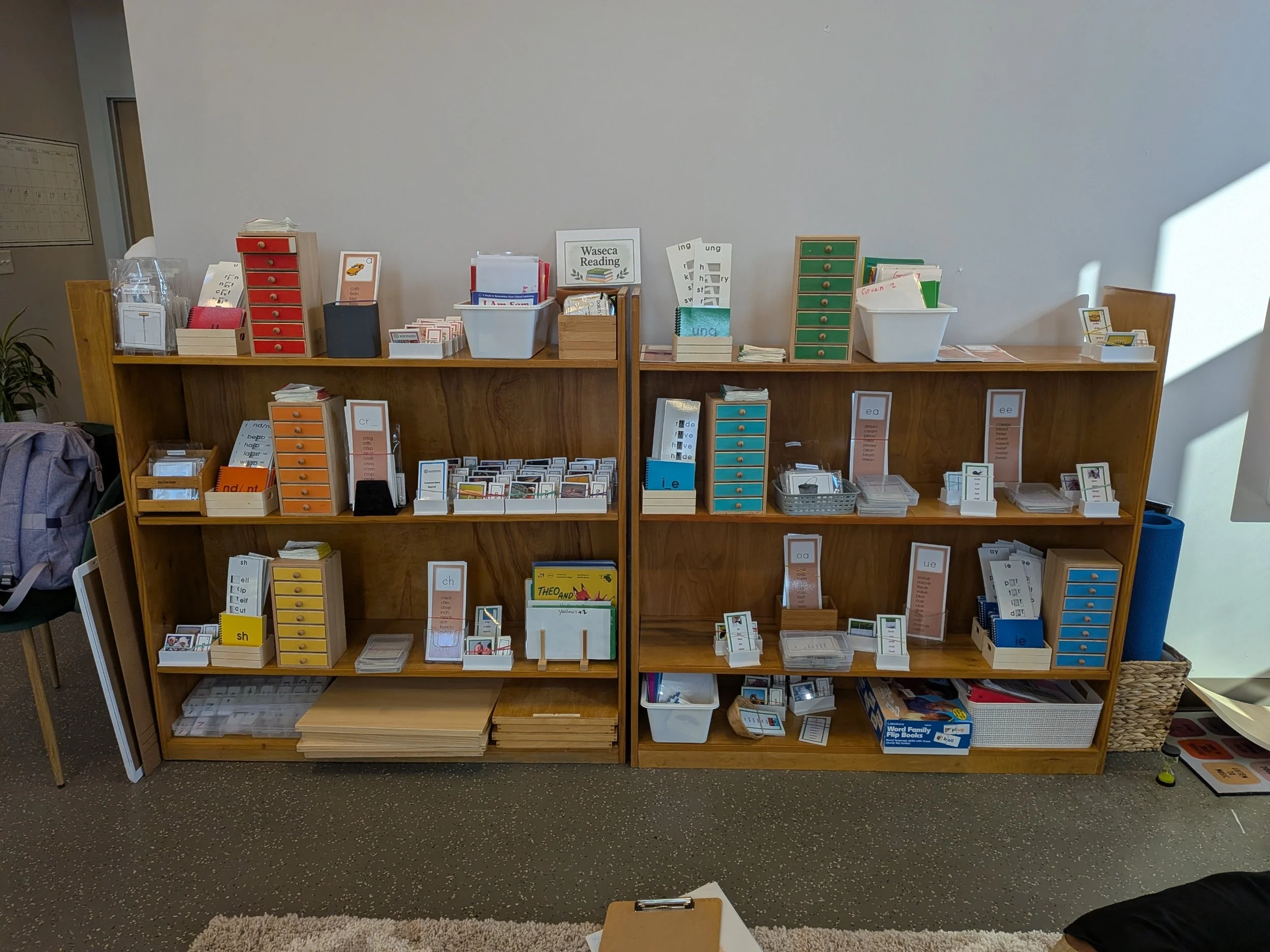
A 80% done language shelf with the various companies’ materials integrated into a logical progression and matching language sequence.
