

A new container
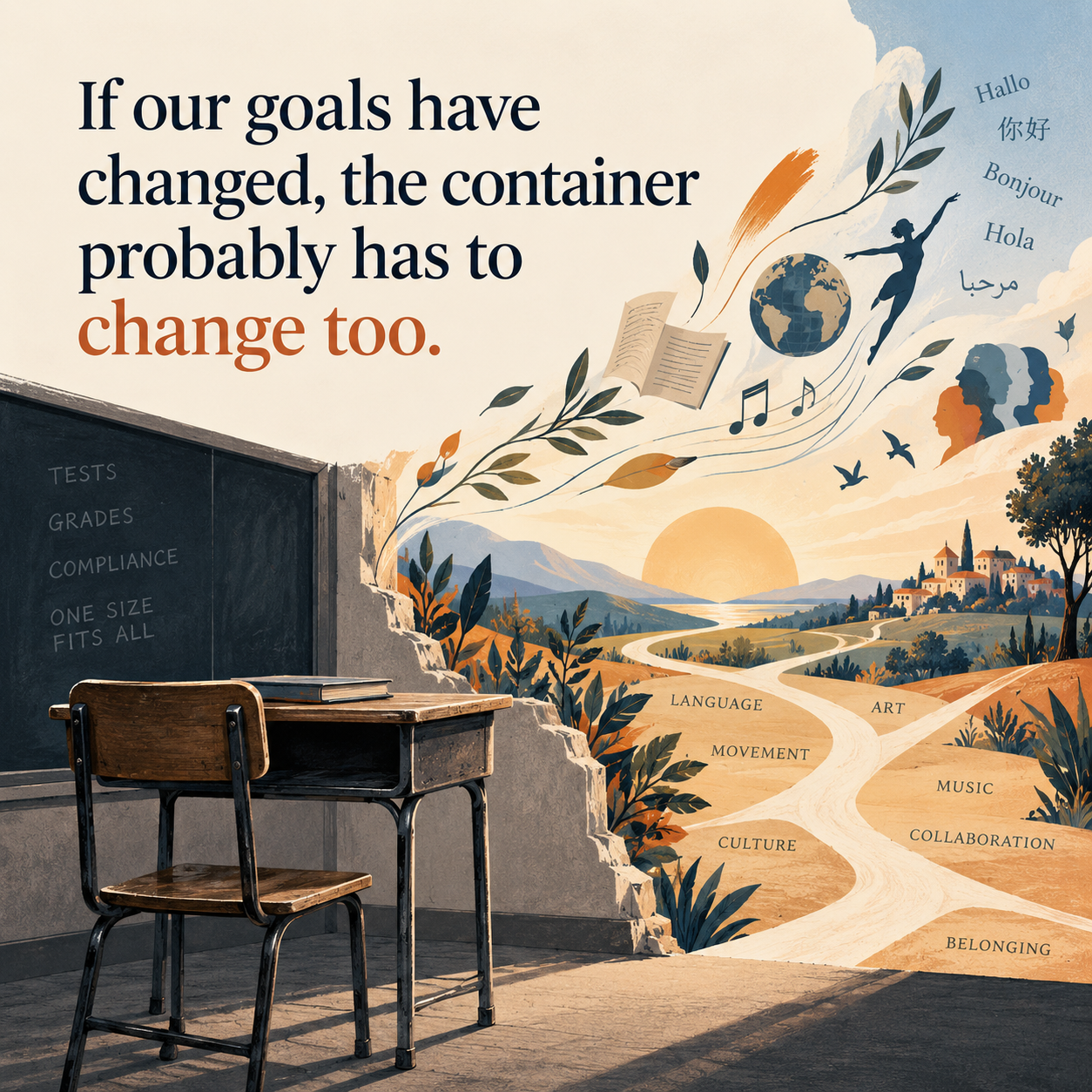
How much of what we call “school” are we still doing simply because it is the structure we inherited?
Not because it is what we now know works best for learning.
Not because it develops the kinds of thinkers, collaborators, problem-solvers, and humans we say we want.
Just because this is what school has looked like for a very long time.
And I think we sometimes tell ourselves a cleaner story about the history of education than is actually true.
Public schooling in the U.S. was shaped by a lot of different goals: literacy, citizenship, expanding access, yes. But also standardization, efficiency, social order, nation-building, and the practical challenge of managing large numbers of children.
You can still see that history everywhere.
Age grouping.
Bell schedules.
Fixed periods.
Seat time.
Standardized pacing.
Large groups moving through the same content according to the same calendar.
And here’s the part that keeps bothering me:
A lot of schools now say they value creativity, critical thinking, collaboration, equity, student agency, belonging, innovation, whole-child development, and preparation for a changing world.
And I believe many of them genuinely mean it.
But then we still teach much of the same curriculum, often in very similar ways, on similar calendars, through similar schedules, using many of the same measurements, with teachers who themselves were trained inside versions of that same system.
So sometimes the language changes faster than the structure does.
We say we want deeper learning, but the pacing guide keeps moving whether the learning is deep or not.
We say we value student agency, but adults still control most of the time, movement, content, and measures of success.
We say we value different ways of thinking, but often ask everyone to demonstrate learning in the same few ways.
We say we want reflective, adaptive teachers, and then spend huge amounts of their time having them write, submit, format, and check lesson plans instead of actually studying student work, observing learning, practicing instruction, getting feedback, and improving the craft.
And then there is another piece I keep thinking about:
Why are so many of the things people most need in order to live well with other humans still treated as extras?
Emotional regulation.
Conflict resolution.
Prosocial skills.
Perspective-taking.
How to build community.
How to repair after harm.
How to communicate across difference.
How to ask for help.
How to set a boundary.
How to recognize manipulation.
How to understand basic human needs in ourselves and in other people.
These are not fringe skills.
They shape relationships, families, workplaces, leadership, wellbeing, democracy, pretty much every part of life.
And yet they are often not what we spend the most time teaching, practicing, assessing, or revisiting.
At the same time, so much of what is officially taught may be useful academically without necessarily being retained, transferred, or applicable once the test is over.
And we also continue reproducing historical narratives that were shaped by colonialism, settler expansion, white supremacy, nationalism, and decisions about whose knowledge was considered legitimate enough to enter the curriculum in the first place.
I’m not saying history, literature, science, math, or academic knowledge matter less.
They matter enormously.
I’m asking why knowing content became the center of education while so many of the skills required to live, relate, cooperate, repair, participate, and build something better were pushed to the margins.
And then look at what gets cut first when budgets tighten.
Art.
Music.
Movement.
Language.
Culture.
SEL.
Community-building.
Those are so often the first things reduced, combined, underfunded, or handed to the least-supported positions, even though they are some of the most transferable and universal parts of being human.
They help us communicate, regulate, create, collaborate, express identity, understand culture, move through emotion, build relationships, and make meaning.
Those are not side benefits.
They are deeply connected to wellbeing and to how people actually function in families, workplaces, communities, and public life.
And yet we often fund them last, train for them least, and pay the people doing that work less than the people teaching what we have decided counts as the “core.”
That hierarchy says something.
Meanwhile, what we know about learning has grown enormously.
We know more about neurodivergence.
Language development.
Memory and retrieval.
Trauma and regulation.
Culture and identity.
Motivation.
Belonging.
Executive functioning.
Learning differences.
The importance of relationships.
The difference between performing well on Friday and actually being able to retrieve, connect, transfer, and use that learning later.
And yet sometimes we take all of that newer knowledge and try to squeeze it into a container whose basic architecture has barely moved.
That feels backwards to me.
I don’t want an education system designed primarily to make children easier to sort, schedule, measure, and manage.
I want one designed around learning and being human.
I want assessment to function as feedback, not a verdict.
I want us asking:
What was actually taught?
What did this learner understand?
What did they retain?
What can they apply somewhere new?
What did this connect to from before?
How far have they moved along the learning progression?
What barriers did we put in the way of them showing us what they know?
And what should we do differently tomorrow because of what we learned today?
I want teachers spending more time actually getting better at teaching.
I want classrooms where kids learn how to disagree, repair, collaborate, ask better questions, change their minds when the evidence changes, recognize when a system is causing harm, and imagine something better.
I want multilingualism, neurodivergence, culture, curiosity, movement, creativity, and different ways of thinking treated as information for designing learning, not deviations we have to somehow fit back into “normal.”
And I still want structure.
Kids need structure. Adults need structure. Communities need structure.
But structure should hold learning, not trap it.
Maybe the question is no longer:
How do we get today’s children to succeed in the school system we inherited?
Maybe it is:
Knowing what we know now about learning, development, identity, technology, culture, wellbeing, and the world children are actually growing into, what would we build if we were allowed to design school again?
Because if our goals have changed, our knowledge has changed, and our world has changed...
the container probably has to change too.
