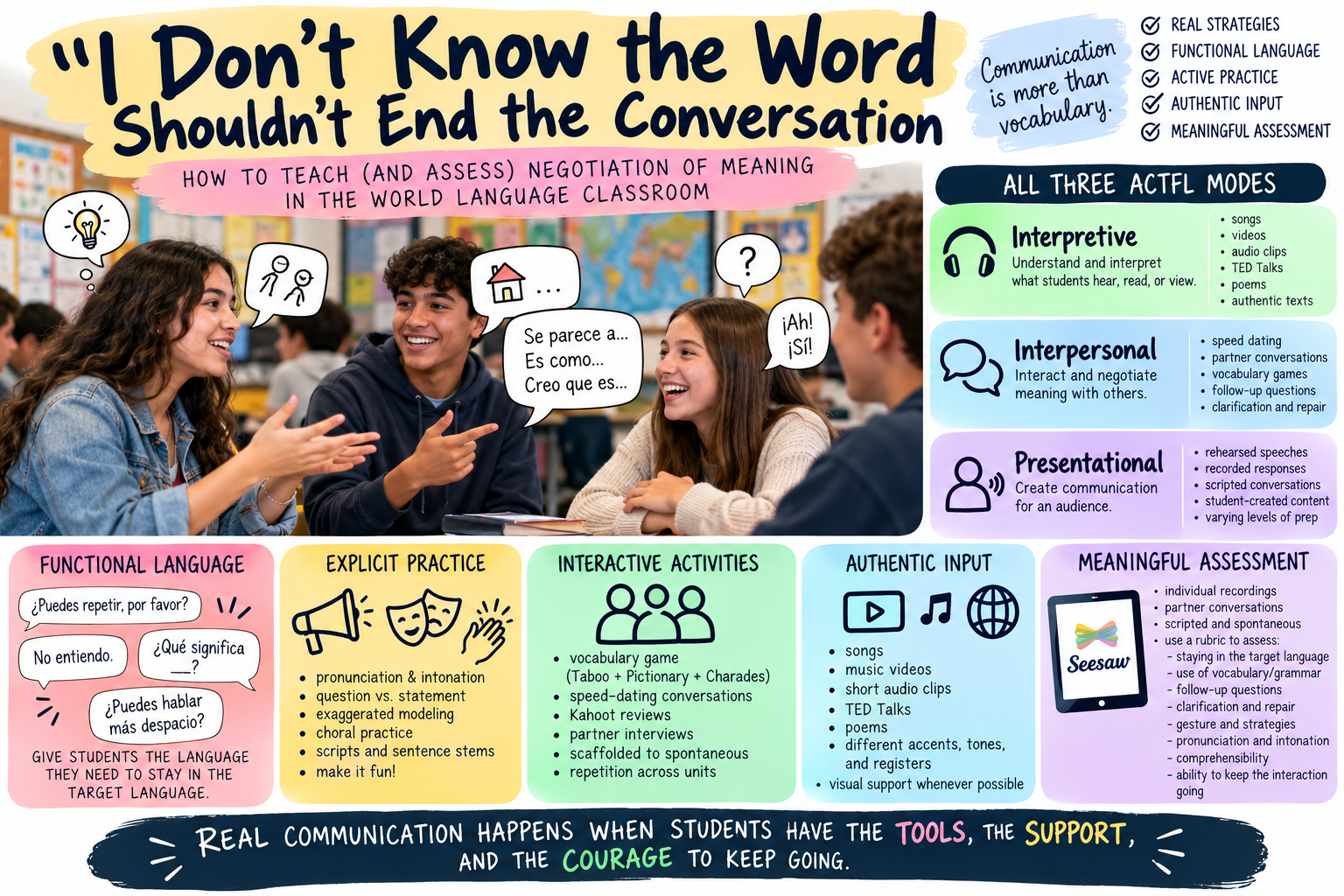
“I Don’t Know the Word” Shouldn’t End the Conversation
Teaching students how to negotiate meaning, stay in the language, and communicate through uncertainty
One of the things I learned very early as an immersion teacher was that knowing vocabulary and knowing how to communicate are not the same thing.
A student can know a lot of words and still freeze.
They can know the grammar and immediately switch to English.
They can understand most of what another person says and still look directly at the teacher the second they miss one piece.
And sometimes the student who knows less language is actually the one who communicates more successfully because they are willing to point, gesture, draw, act something out, describe around a missing word, laugh at themselves, try something that might be wrong, and keep going.
That difference fascinated me throughout my teaching career.
Because sometimes students did need more vocabulary.
But very often, they also needed something else:
They needed to be taught what to do when communication got hard.
Some students already know how to not know
My first full-time teaching job was as a Spanish immersion lead teacher, and before that I had been an assistant and teacher trainee in a school with a large multilingual community.
Many of my colleagues, students, and families regularly moved between languages.
I also grew up bilingual and attended an immersion program myself, so I had spent years watching people understand things they could not necessarily translate word-for-word.
There is a kind of comfort that can develop when you have experience living around more than one language.
You learn that you can understand the gist without catching every word.
You learn to watch people’s faces.
You use context.
You point.
You gesture.
You describe.
You approximate.
You listen for the words you do understand and build outward from there.
You become accustomed to the possibility that communication can still be successful even when it is incomplete.
Years later, teaching high school Spanish, I could sometimes see that experience showing up in my students.
Some students from multilingual homes or communities already seemed to have an intuitive sense of how to navigate a communication gap. Not universally, of course, but often enough that I noticed it.
When they did not know a word, they improvised.
They played charades.
They pointed.
They drew.
They made sound effects.
They tried synonyms.
They used a word they knew and Spanish-ed it into something that may or may not have technically existed.
Sometimes it was gloriously incorrect.
But I knew what they meant.
And so did their partner.
They treated communication like a problem to solve rather than a performance they could fail.
That difference matters.
WIDA’s guidance on interactive learning reflects this same multimodal reality. It notes that multilingual learners may draw on gesture, physical objects, drawings, multiple languages, and other resources to negotiate meaning and co-construct understanding with peers.
Perfectionism can get in the way of communication
I taught in a private college-preparatory high school, which meant I had a lot of very motivated students.
It also meant I taught a lot of perfectionists.
Especially in honors and AP courses, many students were accustomed to getting things right. They cared about grades. They cared about being prepared. They cared about knowing the answer before they raised their hand.
Those traits can serve students very well academically.
But language learning asks something uncomfortable of them.
It asks them to speak before they know everything.
It asks them to make educated guesses.
It asks them to misunderstand people.
It asks them to say something imperfectly in front of their peers and then try again.
For a teenager, that can feel enormous.
And younger high school students brought another layer.
Sometimes I would look at my Spanish I classes, particularly freshman-heavy classes, and realize that the Spanish was only one part of what I needed to teach.
I was also teaching:
How close do you stand to another person during a conversation?
How loudly do you need to speak for someone standing a foot away to hear you?
How do you make eye contact without staring at someone?
How long does a handshake last?
What do you do when someone did not hear you?
How do you repeat yourself?
How do you enter a conversation?
How do you leave one?
How do you respond when you feel awkward?
Sometimes my students did not need more Spanish first.
They needed to learn how to have the interaction the Spanish was supposed to live inside.
Communication is a stack of skills
That realization changed the way I thought about teaching interpersonal communication.
Negotiating meaning is not one skill.
It is a stack of skills.
A student has to recognize what is happening in the interaction.
They have to figure out what kind of response is appropriate.
They need language they can use to make that response.
They need to deliver it in a way another person can understand.
They need to notice whether the other person understood.
They need to clarify or adjust when they did not.
And they have to tolerate enough discomfort to keep going while all of this is happening.
ACTFL defines interpersonal communication as learners interacting and negotiating meaning in conversation to share information, reactions, feelings, and opinions. Interpretive communication involves understanding and analyzing what is heard, read, or viewed, while presentational communication involves communicating information and ideas to an audience.
That framework mattered enormously in how I taught.
Because telling students, “Speak Spanish,” is not enough.
We have to teach them how.
If I want students to stay in the language, I have to give them language for staying there
Around my classroom, I kept functional language visible.
Not just vocabulary from the current chapter.
Language students actually needed in order to function in the room.
No entiendo.
Por favor, clarifica.
Repite, por favor.
Más lento.
¿Cómo se dice ___ en español?
¿Cómo se dice ___ en inglés?
And then, as their proficiency grew, we added language for more complex conversational moves.
For repair:
Disculpa, no quise ofender.
Perdón, creo que no me comuniqué bien.
For follow-up:
¿Puedes dar un ejemplo?
¿Se parece a qué?
Úsalo en otra frase, por favor.
For disagreement:
No estoy de acuerdo porque…
Entiendo, y estoy en desacuerdo con este punto…
For buying time:
Déjame ver…
Estoy pensando…
Lo que creo yo es…
Those phrases were not decoration on a poster.
They were tools.
Because if every moment of confusion requires switching back into English, students learn very quickly that English is the escape hatch.
ACTFL recommends that teachers and students use the target language as much as possible, including its long-standing recommendation of 90% or more during instructional time. Importantly, that guidance does not simply say “use more target language.” It also recommends making meaning clear through gestures and visual support, checking comprehension, negotiating meaning, encouraging spontaneous language use, and explicitly teaching students strategies for requesting clarification or assistance.
That distinction matters.
Maintaining a target-language environment is not just a rule.
It is an instructional design problem.
Students need the tools that make the expectation possible.
Rigor and support have to travel together
This was also where I saw the importance of program fidelity.
One teacher can create beautiful target-language routines, but if another adult immediately translates everything for students, or expectations disappear whenever someone becomes uncomfortable, students learn that persistence is optional.
And this can become especially complicated when students or families are anxious about grades.
If the expectation is “stay in the language unless you become uncomfortable enough,” then students eventually discover the out.
That does not mean students should be abandoned inside confusion.
Quite the opposite.
High expectations only work when the scaffolds are equally strong.
I could expect students to remain in Spanish because I had taught them what to do when they got stuck.
We practiced it.
We modeled it.
We made it visible.
We made it funny.
We did it again.
And again.
And again.
Rigor and support together.
“Correct” is not always the same as understandable
Another thing we practiced explicitly was what communication should actually sound like.
Students might know the words of a question without producing it in a way that sounded like a question.
So we played with intonation.
Say the same phrase as a statement.
Now as a question.
Put the emphasis on a different word.
What changed?
What does the listener assume now?
We practiced pronunciation.
Volume.
Pacing.
Emphasis.
Sometimes chorally.
Sometimes in small groups.
Sometimes individually.
Sometimes recording ourselves.
Sometimes intentionally making it absurd.
I would exaggerate something badly so students could hear and see why it did not work, and then we would try it again.
Those details matter because communication does not live only inside vocabulary and grammar.
It lives in tone, rhythm, gesture, facial expression, physical distance, timing, and the ability to notice what another person is doing.
The ACTFL Performance Descriptors similarly include communication strategies as part of how learners maintain communication and make meaning, alongside language control, vocabulary, comprehensibility, and cultural awareness.
Accent was something we explored, not something I used to punish students
I did assess pronunciation, intonation, and accent awareness.
But I never believed every student should be expected to reproduce every Spanish sound or regional accent with the same level of precision.
People have different auditory abilities.
Some students can hear tiny differences in sound almost immediately.
Others need much more repetition before they can distinguish them.
The same is true physically.
Some people can imitate a new accent with remarkable ease. Others need much more deliberate practice learning where to place their tongue, how to shape their mouth, or how to coordinate unfamiliar movements.
Those things can improve with instruction and practice, and we did practice them.
We worked on mouth position.
We exaggerated sounds.
We practiced intonation.
We listened and repeated.
We recorded ourselves.
We tried again.
But I was far more interested in whether students were becoming more understandable, more intentional, and more aware of how Spanish sounds than in penalizing someone because they could not perfectly reproduce a particular accent.
That is one reason I prefer thinking in terms of pronunciation, intonation, comprehensibility, and growth rather than treating “native-like accent” as the goal.
ACTFL’s performance framework also distinguishes language control from broader comprehensibility and communication strategies rather than reducing successful language use to one narrow measure of correctness.
And sometimes we made accent work deliberately fun.
When we were studying colloquial or casual language, we followed well-known Spanish-speaking YouTubers and other creators from different countries and regions.
We would listen for phrases that were especially characteristic of that speaker’s variety of Spanish, including colloquialisms, rhythm, pronunciation, and intonation.
Then we tried them ourselves.
Students would imitate the phrase, record themselves, listen back, and see how closely they could reproduce what they heard.
Sometimes it became a friendly challenge.
Who could hear the difference?
Who could reproduce the rhythm?
What changed when the speaker came from a different region?
What vocabulary or pronunciation suddenly sounded different?
The goal was not to decide that one accent was more correct than another.
It was almost the opposite.
I wanted students to understand that Spanish does not have one voice.
It changes across countries, regions, communities, generations, and contexts.
Practicing those differences helped students develop their ears while also making them more comfortable with the reality that authentic Spanish will not always sound like the carefully paced voice from a textbook recording.
And honestly, it was fun.
Practice the interaction, not just the vocabulary
One of my favorite ways to do this was through repeated interactive routines.
I used the same structures at different levels and at different points in a unit, but I changed how much support students had.
One of those routines was what I usually thought of as a kind of speed-dating activity.
I would play music while students moved around the room.
The music stopped.
They paired with whoever was closest.
Then they received a prompt.
Early in a unit, they might have:
the vocabulary list,
key phrases,
sentence stems,
or even an entire script.
Maybe I assigned who was Person A and who was Person B.
Then the music started again.
New partner.
We repeated it.
Later, I might remove the full script.
Then the sentence stems.
Then most of the vocabulary support.
Eventually I could give them only a communicative prompt:
Ask what your partner did this weekend.
Ask two follow-up questions.
Politely disagree.
Propose another idea.
Clarify something you did not understand.
Accept an invitation but change one detail.
This progression became especially clear to me through AP Spanish Language training.
One of the things I loved about the simulated conversation format was that students might be told what kind of communication move to make without being given the actual language:
Agree and extend.
Reject and propose an alternative.
Clarify.
Respond appropriately.
That requires multiple layers of understanding.
A student has to know what it means to disagree politely before they can figure out how to disagree politely in Spanish.
That is why I increasingly taught those moves explicitly.
The structure of an activity could stay familiar while the language demand increased.
Students did not have to spend mental energy learning a brand-new game every time. Instead, I could gradually transfer more responsibility to them.
See it. Rehearse it. Use it with support. Repeat it. Retrieve it. Adapt it. Use it spontaneously.
A vocabulary game that secretly taught circumlocution
Another favorite activity happened at the beginning of vocabulary units.
It was basically a mashup of Taboo, Pictionary, and Charades.
Teams competed to identify as many words from the unit as possible.
Depending on the round, students might have to:
describe the word without saying it,
give synonyms or related words,
act it out,
draw it,
gesture,
use clues,
or find another way to communicate the idea.
And it all happened in Spanish.
The students giving clues were practicing circumlocution.
The students guessing were practicing interpretive listening.
The rest of the team was listening and mentally retrieving the vocabulary even when it was not their turn.
Everyone was involved.
And because the pace was fast, students did not have five minutes to construct the world’s most grammatically pristine sentence.
They had to communicate.
That pressure actually helped some of my perfectionist students.
There was not enough time to polish everything.
Sometimes you just had to flap your arms, point toward the window, make a questionable sound effect, and hope your team understood you.
That is not a failure of language learning.
Sometimes that is language learning.
WIDA’s guidance on interactive learning emphasizes that interaction gives multilingual learners opportunities to experiment with language, learn from peers, and use multimodal resources such as gestures, physical objects, and drawings to negotiate meaning.
Retrieval should feel functional
I also used tools like Kahoot regularly.
Sometimes it was a vocabulary word.
Sometimes students chose the correct ending to a sentence.
Sometimes they identified the phrase that made sense in a particular context.
Sometimes it was a ten-question check-out at the end of class.
It was fun, but fun was not the only reason I used it.
Real-life communication happens quickly.
We do not usually walk into a grocery store carrying a perfectly organized vocabulary list and a dialogue we rehearsed the night before.
Eventually we have to retrieve language.
We have to recognize what fits.
We have to respond.
The goal was not to yank away scaffolds as quickly as possible.
The goal was to give students enough support that, eventually, they could carry more of the communication themselves.
Students also need to hear what real language sounds like
Speaking practice was only one part of this.
Almost every day, I tried to give students some kind of authentic interpretive input.
A song.
A short audio clip.
A music video.
A short TED Talk.
A poem.
A video.
Whenever possible, I liked having something visual with the audio because communication gives us so much more information than words alone.
Facial expressions matter.
Gesture matters.
Context matters.
Who is speaking to whom matters.
I wanted students hearing different accents, tones, registers, levels of formality, casual conversation, academic language, and different ways Spanish sounds across communities.
I wanted them to hear enough Spanish that they stopped expecting Spanish to sound like one person, one accent, one register, or one perfectly paced classroom recording.
And I wanted students to understand something else:
Comprehension does not mean translating every word.
Sometimes understanding means catching enough information to know what is happening.
That itself is a skill.
ACTFL’s interpretive mode explicitly centers understanding and analyzing what learners hear, read, or view, rather than equating interpretation with word-for-word translation.
Different modes require different kinds of communication
This is also why my assessments did not all look the same.
ACTFL organizes communication around three modes:
Interpretive: understanding, interpreting, and analyzing what students hear, read, or view.
Interpersonal: interacting with another person and negotiating meaning.
Presentational: communicating information, concepts, and ideas to an audience to inform, explain, persuade, or narrate.
Those are different demands.
A student giving a presentation they practiced for several days is demonstrating one kind of performance.
A student responding to an unexpected question after thirty seconds of preparation is demonstrating another.
A student listening to a partner, realizing they misunderstood, asking for clarification, adjusting their response, and keeping the conversation moving is showing something different again.
None of those is inherently more “real” than the others.
They simply reveal different things about what the student can do.
That distinction also matters because interpersonal communication requires active negotiation of meaning, while presentational communication does not offer the same immediate opportunity for clarification and repair.
Seesaw let me actually see each student’s communication
One of my favorite tools for capturing this was Seesaw.
Students could record themselves:
reading,
giving a presentation,
reciting something they had prepared,
performing a script,
having a partner conversation,
interviewing another student,
or responding to a quick speaking prompt.
Sometimes they had a lot of preparation.
Sometimes very little.
Sometimes they could rehearse and re-record.
Sometimes I wanted to capture something much closer to spontaneous speech.
The advantage was that I could go back later and actually listen to each student individually.
Not just the loudest person in the group.
Not just the handful of students I happened to hear while circulating.
Each student.
And I could assess them against a rubric.
If communication matters, assess communication
That rubric could include things like:
Did the student stay in the target language?
Did they use the target vocabulary or grammatical function?
Were they comprehensible?
Did their pronunciation and intonation support understanding?
Did they respond to the other person rather than simply recite something?
Did they ask follow-up questions?
Did they notice confusion?
Did they clarify?
Did they repair misunderstandings?
Did they use gesture or another strategy when needed?
Did they keep the interaction going?
Did they show growth from Emerging to Developing to Proficient to Advanced performance?
ACTFL’s Performance Descriptors explicitly include not only language control and vocabulary but also communication strategies, including the strategies learners use to negotiate meaning, understand messages, express themselves, and maintain communication.
That mattered to me because assessment sends a message.
If I tell students communication matters and then grade only grammar and vocabulary accuracy, I have taught them something too.
I have taught them that communication does not actually matter.
The goal was never perfection
I absolutely cared about accuracy.
Vocabulary matters.
Grammar matters.
Pronunciation matters.
Increasing precision matters.
But communication cannot wait until every one of those things is perfect.
Some of the strongest communicators I taught were not the students who always produced the most flawless language.
They were the students willing to use what they had.
They could describe the word they forgot.
Ask someone to repeat themselves.
Try another phrase.
Gesture.
Draw.
Clarify.
Listen.
Adjust.
Laugh.
Try again.
And eventually, as their vocabulary, grammar, confidence, and proficiency grew, they needed those emergency strategies less often.
But they never stopped needing the larger skill underneath them:
How do I stay in communication with another human being when understanding is imperfect?
That is not a workaround for language learning.
That is one of the things language learning is supposed to teach us.
A student who does not know the word but knows how to stay in the interaction, negotiate meaning, repair misunderstanding, and keep trying is showing me something enormously important.
They are learning how to communicate.
Sources and further reading
ACTFL, World-Readiness Standards for Learning Languages: Standards Summary.
ACTFL, NCSSFL-ACTFL Can-Do Statements.
ACTFL, Use of the Target Language in the Classroom.
ACTFL, Performance Descriptors for Language Learners.
WIDA, Interactive Learning With Multilingual Learners in Content-Area Classrooms.